Approximate age
An Earth history experiment
 Dig Earth Studio Lab
Your Birth
in Deep Time
4.6 billion years. 365 days. Where do you land?
Earth is about 4.6 billion years old, far too long to picture easily.
So we’ve compressed the entire history of our planet into a single calendar year.
January 1 marks the formation of Earth. December 31 marks the present day.
On this scale, neighbouring calendar dates are about 12.6 million years apart .
That means the rise of continents, the first life, complex animals, dinosaurs, mass extinctions and humans all have to fit somewhere between New Year’s Day and December 31.
Pick a birthday, yours or someone else's, and discover what Earth was like on that date in deep time.
January 1
Earth forms
4.6 billion years ago
December 31
Today
0 years ago
Whose birthday are we sending into deep time?
Choose a birthday
Yours, a friend's or a family member's. We only need the day and month, not the birth year.
No birthday information is stored or sent anywhere.
Your place in deep time
Your birthday goes very deep.
4.6 billion years ago
Today
Geological time
Your world in one sentence
Earth was already deep into its long geological story.
Life on Earth
Atmosphere & oceans
What the world looked like
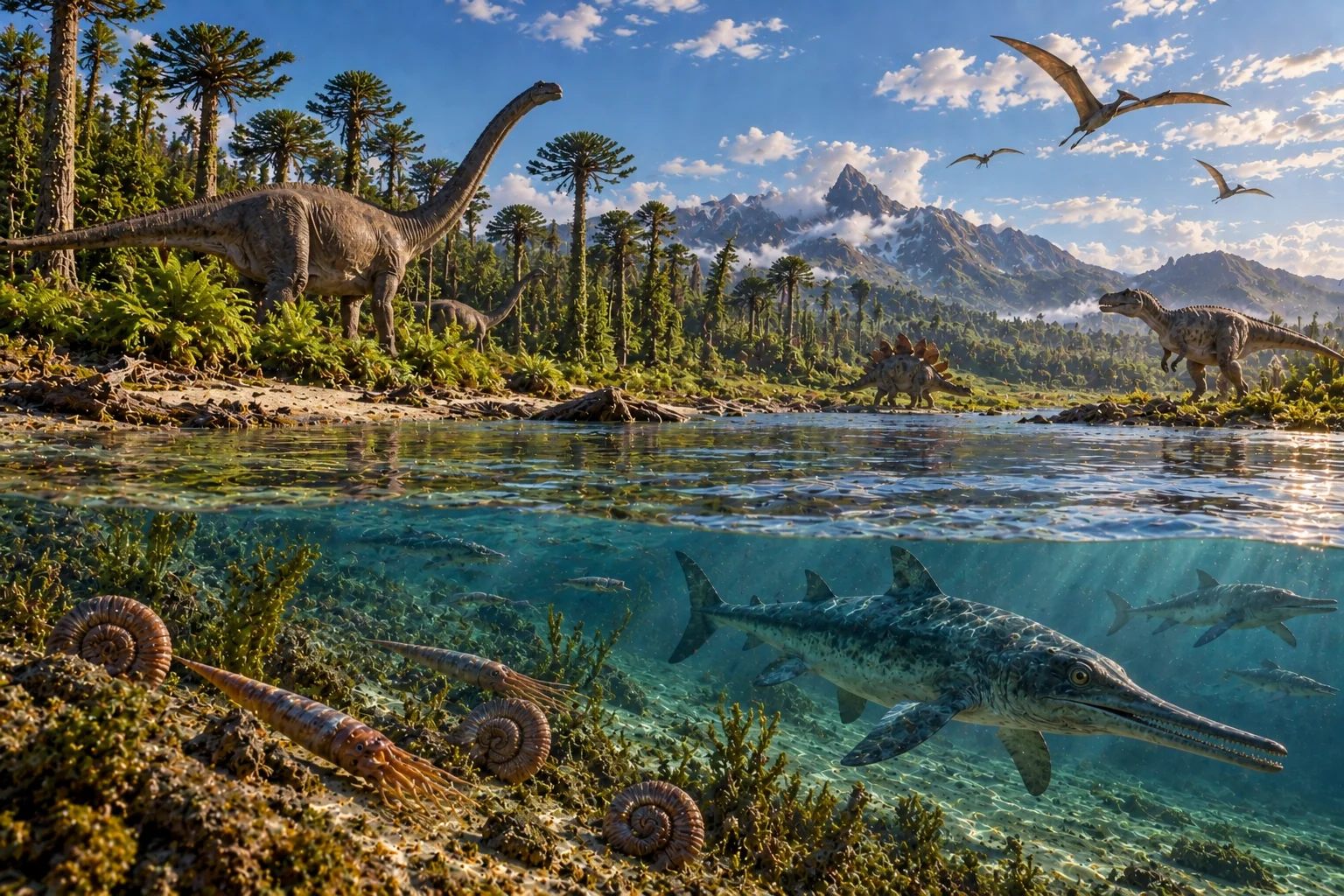
This scene represents one well-known moment within the broader geological interval around your birthday. It is an artist's reconstruction, not a literal view of the exact calculated date.
Around 150 Ma
On the real geological timescale
Where does your birthday belong?
The calendar is an analogy. Geologists divide Earth history into formal units such as eons, eras, periods, subperiods and epochs.
Life around your time
Who might have shared your world?
These examples represent the broader interval around your deep-time birthday rather than organisms living on one exact calendar date.
Look around your moment
Your deep-time neighbourhood
Your birthday sits between other milestones in Earth history. Select either neighbour to travel there.
Your birthday
Your place in deep time
This is where your birthday lands on the compressed history of Earth.
These are selected milestones, not a complete geological timeline. Many changes happened gradually over millions of years.
Continue travelling
Explore another moment
Choose an earlier or later milestone to continue through Earth history.
From calendar to geology
Explore the Geological Timescale
Geological time is organised like a set of nested boxes. Choose an eon first. Where formal subdivisions exist, the next level will appear below it.
Your birthday
Eons
Start here
Eras
Periods
Epochs / series
Geological timescale
Choose an eon
Start with one of the four major eons above.
Calendar connection Select a geological unit to see where it falls on the Deep Time Calendar.
Formal geological boundaries follow the International Commission on Stratigraphy's International Chronostratigraphic Chart v2026/06. The birthday activity rounds Earth's age to 4.6 billion years, while the formal Hadean begins at 4567 Ma. This creates a small analogy-only interval at the very beginning of January.
Keep exploring
Explore the Deep Time Calendar
The entire 4.6-billion-year history of Earth is squeezed into one year. Pick a month to see how unevenly familiar events are spread across the calendar.
1 date step
about 12.6 million years
1 hour
about 525,000 years
1 minute
about 8,750 years
1 second
about 146 years
4.6 billion years in one line
Selected milestones are shown as dots
Selected month
December
Milestones
What happens here?
Zoom in
December gets crowded
Many familiar chapters of Earth history are squeezed into the final month. Scroll across the dates, then look at what happens during the final 24 hours of the analogy.
The final 24 hours, zoomed in
Even the final 24 hours represent about 12.6 million years. The genus Homo appears only in the evening, and Homo sapiens arrives close to the present.
18:40 · genus Homo
23:26 · Homo sapiens
Calendar positions are approximate. Birthday inputs are treated as evenly spaced date markers from January 1 at Earth's formation to December 31 at the present. This lets the first and last dates match the two endpoints of the analogy. The final-24-hours zoom is a separate close-up of the last roughly 12.6 million years.
Part of the Dig Earth Studio Lab
← Explore all interactive Earth science experiments in the Lab
A note on deep time
A calendar is only an analogy.
These dates are not literal anniversaries. Geological events often unfold over thousands, millions or even hundreds of millions of years.
Each result represents the world around that point in Earth history, compressed onto our calendar.
For birthday results, January 1 is anchored to Earth's formation and December 31 is anchored to the present. The dates between them are evenly spaced across 4.6 billion years.
Formal geological boundaries on this page follow the International Commission on Stratigraphy's International Chronostratigraphic Chart v2026/06.