We Will Rock You
A Crash Course in Reading Rocks
Start with the basic clues: what a rock is made of, how old it is, how it got there and why landscapes are stories rather than scenery.
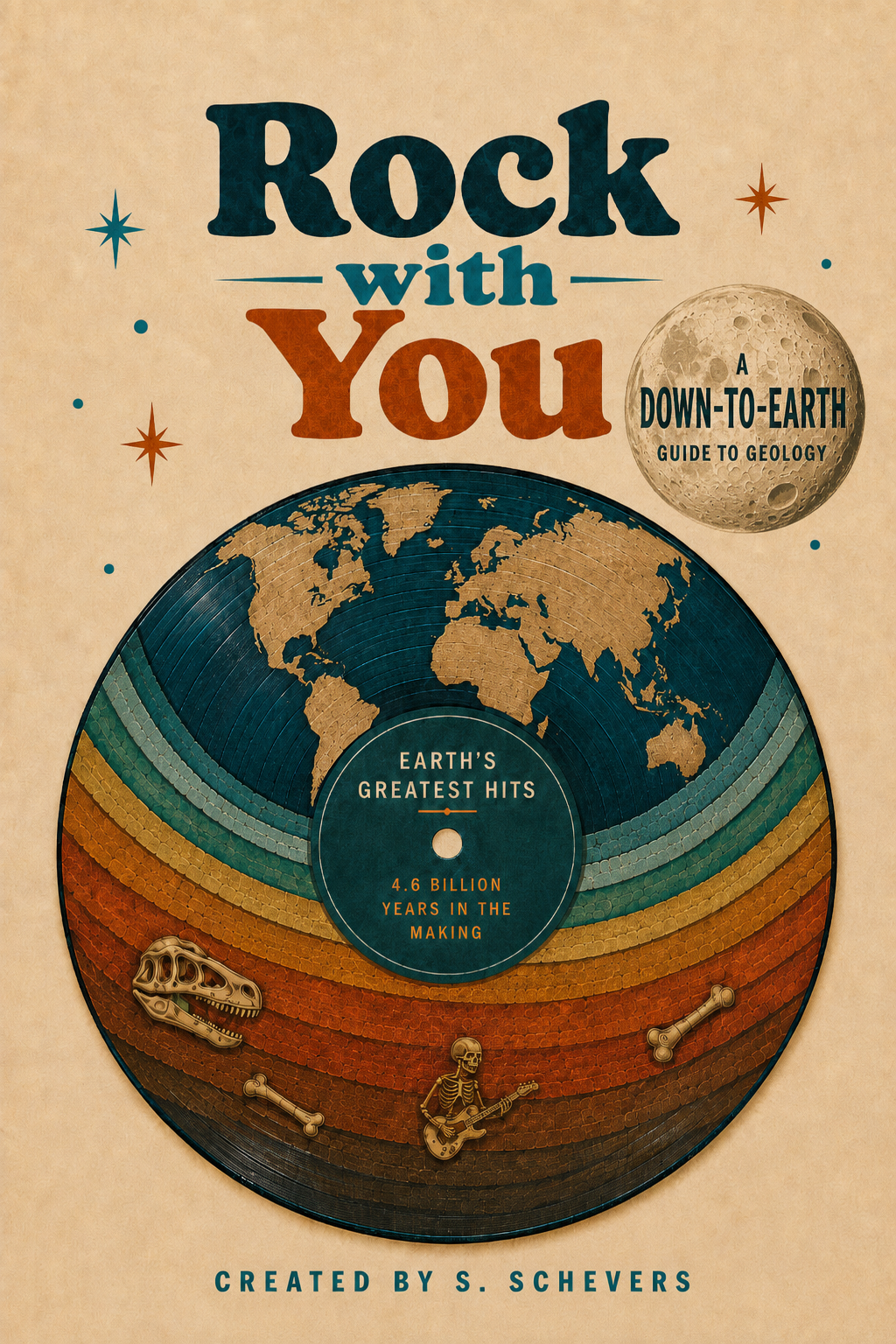
The book
A down-to-earth guide to geology
Earth has been keeping receipts for 4.5 billion years. Geology is how we read them.
From drifting continents and erupting volcanoes to ancient oceans, fossils and landscapes buried beneath our feet, Rock With You explores how Earth works and how we know what happened long before anyone was around to see it.
Clear, visual and occasionally irreverent geology for curious readers. No science background required. No rock hammer either.
Geology, minus the jargon avalanche
Geology is not a catalogue of rocks. It's the story of a planet that refuses to sit still.
Mountains rise where oceans used to be. Continents wander. Volcanoes build land and destroy it again. Rivers rearrange landscapes. Tiny fossils turn up in places they have absolutely no business being.
Rock With You is about learning to see the clues. A roadside cutting stops being a wall of grey rock and becomes evidence. A pebble becomes a traveller. A mountain becomes a crime scene with very slow suspects.
The science stays real. The textbook voice does not.
Inside the book
The book starts by learning how to read rocks, then follows the evidence through deep time, plate tectonics, mountains, volcanoes, earthquakes, Earth's history and finally the geology woven through everyday life.
A Crash Course in Reading Rocks
Start with the basic clues: what a rock is made of, how old it is, how it got there and why landscapes are stories rather than scenery.
The Three Rock Families
Follow igneous, sedimentary and metamorphic rocks through erosion, burial, pressure, melting and the endlessly recycling rock cycle.
Reading Time in Stone
Learn how geologists put events in order, date rocks with radioactive clocks and read the gaps where millions of years have disappeared.
A Restless Earth
Go beneath the surface to Earth's layers, moving plates, mantle convection and the forces that keep the planet's outer shell in motion.
Follow convergent, divergent and transform boundaries into trenches, mountain ranges, folds, faults and the ancient roots hidden beneath today's landscapes.
Explore volcanoes and earthquakes, why eruptions behave differently, how seismic waves reveal what happened and why prediction remains difficult.
Travel from the Precambrian and Cambrian Explosion through Pangaea, mass extinction, dinosaurs and eventually a world that starts to look familiar.
Bring geology home through cities, construction materials, groundwater, energy, minerals, hazards, soil and even the ingredients inside your phone.
Try before you dig
Start at the beginning with the Opening Act and Chapter 1: The Shell on the Mountain. No email address. No signup. Just geology.
If I got a penny every time someone heard I'm a geologist and immediately started telling me about a documentary they saw on excavations in Egypt, I would have 13 cents by now. I'd have more if I actually went to more parties. Most people, it turns out, genuinely have no idea what geology actually is — somewhere between “rocks” and “dinosaurs” and “that thing with pyramids,” with the actual subject rarely making an appearance. I've made peace with explaining the difference at every single party I will ever attend for the rest of my life.
And that's genuinely strange, if you stop to think about it for more than a few seconds. This is a subject that decides which cities can exist and which ones slowly tilt into the ground, what's in your phone, what's in the ground under your house, what you can grow, drink, and burn, and it still somehow manages to stay almost entirely invisible to the people living directly on top of it, every single day of their lives.
This book exists to fix that, at least a little. Geology has spent decades sitting quietly in the corner of public attention, overshadowed by flashier sciences with better marketing, quietly shaping our daily lives in ways most people don't notice, and getting none of the credit for it. I'd like to drag it out of that corner.
This book is for anyone willing to look past a first impression — an untrained eye looks at a boring stretch of roadside rock and sees exactly that, while the same eye, with a little bit of training, sees an entire history waiting to be asked a question. No science background required, no rock hammer. Understand a little geology, and you'll start seeing how relentlessly connected everything actually is — rock feeding climate, climate feeding life, life feeding back into the rock, a loop that's been running for four and a half billion years and is still running directly underneath you right now, shaping our very lives. Notice that, and the world around you starts making a lot more sense.
None of that stays abstract for long, either. It's about to get personal.
Somewhere out there is a mountain, a countertop, or a boring stretch of roadside rock with your name on it. Let's go find out what it's been trying to tell you.
Let's get rocking.
Somewhere high up in the mountains, on rock so far above sea level that breathing becomes a whole personality trait, climbers occasionally find something that shouldn't be there: a fossilized seashell, sitting quietly in the stone, as if it had wandered up for the view.
It hasn't wandered anywhere, of course. Shells don't hike. What actually happened is stranger than that: the rock it's sitting in used to be the floor of a shallow sea, and at some point over the last several hundred million years, that entire seabed — shells, mud, and all — got shoved thousands of meters into the sky and left there, frozen mid-collision, while nobody was watching.
This is, if you think about it for more than a few seconds, an unreasonable thing for a planet to do. Mountains are supposed to be the opposite of oceans — tall and dry versus low and wet. And yet there they are: fossilized clams, sitting near the summit of some of the tallest mountains on Earth, patiently waiting for a climber, gasping for oxygen, to notice something is deeply wrong with their sense of geography.
Here's the part that should bother you a little: none of this happened quickly, and none of it happened gently. To move that seashell required forces enormous enough to lift solid rock thousands of meters into the air — and yet the shell itself is still recognizable, not destroyed or erased, quietly waiting in stone. That combination — violence on a scale that's hard to picture, unfolding at a pace too slow to ever actually witness — is basically the whole of geology in miniature.
This, in a nutshell, is what geology is: reading a story that was never meant to be read, written in a language built from a surprisingly small set of clues — rock types, textures, angles, cracks — but an absurdly, almost stupidly long timeline. Finding a marine fossil at the top of a mountain isn't a freak occurrence; it's just the planet keeping receipts of its own history in a very unexpected place.
The good news is that language isn't actually that hard to learn. It starts with a shift in the question you ask — not only “what is this,” but “what was this, and what happened to it since.” But asking the right question only gets you halfway there; you also need a few basic tools to actually answer it, which is exactly what the rest of this book is for. Once you've got both, you can't really stop. Mountains stop looking like just nice scenery and start looking like crime scenes. You'll never look at a mountain — or a seashell — quite the same way again.
Still digging?
Continue with Rock With You in paperback or ebook.
Choose how to read
Get the paperback online, order it through a bookstore, or read the ebook on your preferred device.
Paperback
The physical edition of Rock With You, available directly through Amazon.
Buy on Amazon ↗Bookstores & libraries
Prefer your local bookstore? Rock With You is distributed through IngramSpark and can be ordered by bookstores and libraries through the Ingram distribution network.
Give the ISBN to your bookstore or library when asking them to order the paperback.
Ebook
Same planet. Considerably lighter. Choose your preferred ebook store.
The Lab
Explore deep time, experiment with climate, investigate earthquakes and build volcanic eruptions through free interactive Earth science experiences.
Enter the LabRock With You
The planet has been telling the story all along. You just need to know where to look.